
Why Choose a Compact UAV BMS for Your Drone Battery?

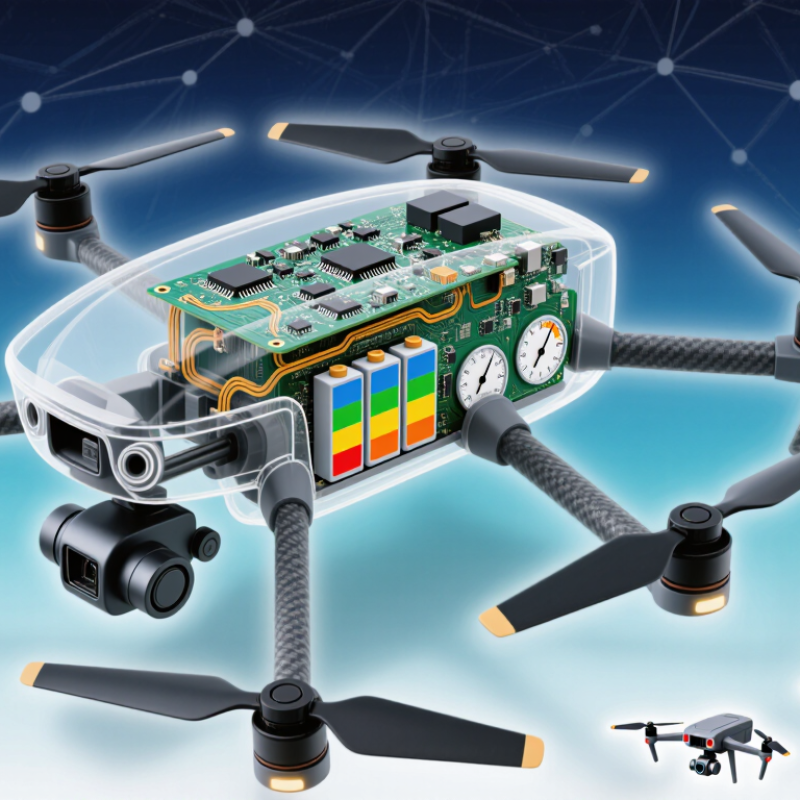
A drone battery can fail quietly, then drop power within seconds. That risk makes the compact UAV BMS more than a miniature circuit board. It becomes the battery’s watchkeeper during launch, hovering, and landing. A suitable system monitors cell voltage, temperature, current, and state of charge inside a tight fuselage. It also supports balanced charging and controlled discharge. Small details matter. A loose thermal sensor can distort flight decisions.

Industry data supports this focus. MarketsandMarkets estimates that the global drone market will grow from USD 30.6 billion in 2024 to USD 55.8 billion by 2029. Its report identifies commercial adoption and autonomous operations as important growth drivers. Meanwhile, Mordor Intelligence projects the battery management system market to expand from approximately USD 8.65 billion in 2024 to USD 16.06 billion by 2029. These figures suggest stronger demand for compact, connected battery protection.

Battery-management specialist Davide Andrea calls the BMS “the brain of the battery pack.” That description is practical, not decorative. The system must interpret imperfect readings and react before heat, imbalance, or deep discharge becomes dangerous. However, smaller is not always better. Designers must still examine balancing accuracy, telemetry, communication protocols, peak current handling, and thermal placement. A compact unit may save valuable space, yet limited cooling can create hidden weaknesses. This article explores how to choose a Compact Uav Bms with evidence, field experience, and realistic engineering judgment. Some specifications look impressive on paper. Flight testing may disagree.
Why Choose a Compact UAV BMS for Your Drone Battery?

Map UAV Battery Specs: 3.6–3.7 V Cells and 4.2 V Charge Limits

Why Choose a Compact UAV BMS for Your Drone Battery?

A compact UAV battery management system saves space, but voltage accuracy matters more than a few grams. Many lithium-ion cells are rated at 3.6 or 3.7 V nominally. That is not their full-charge voltage. For common cells designed for a 4.2 V limit, charging beyond that level can damage cells and create a safety risk. Always check the cell datasheet; not every chemistry uses the same limits.

Pack voltage rises with cells connected in series. A 4S pack made from 3.6 V cells is nominally 14.4 V, while its maximum charge voltage is 16.8 V when each cell reaches 4.2 V. That difference is easy to overlook.

A suitable BMS should monitor individual cell voltages, support balancing, and match the pack’s current and temperature requirements. On a small aircraft, wiring, airflow, and board placement also affect heat.

A bench check with a multimeter can confirm the charger’s final voltage before flight. It is a simple check, though it does not replace proper cell specifications or careful pack testing.


Quantify Payload Gains: 150–250 Wh/kg Cell-Level Li-Ion Benchmark (DOE)

DOE’s 150–250 Wh/kg benchmark describes lithium-ion cells, not a complete UAV battery.

At 200 Wh, that range implies roughly 1.33 kg of cells at 150 Wh/kg, versus 0.8 kg at 250 Wh/kg. The difference is about 0.53 kg before adding the enclosure, wiring, and battery management system.

A useful benchmark. It is not a guaranteed payload gain.

A compact BMS can limit its own weight and volume, leaving more room for mission equipment. It also monitors cell voltage, current, and temperature, and may balance cells to support reliable operation. But shrinking the board alone cannot create extra energy or compensate for undersized cells.

The estimate is useful, but incomplete. Pack-level density, propeller demand, flight time, and temperature all affect the real trade-off. I would compare complete battery mass and measured flight performance, not cell figures alone, before claiming a payload increase.

Define Compact BMS Functions: Monitoring, Balancing, and Protection

A compact UAV BMS does three practical jobs: it measures, balances, and protects. Voltage sensing tracks each cell, while current and temperature readings help estimate remaining charge and detect abnormal loads. In a six-cell pack, a 20 mV difference across each adjacent cell can create a 100 mV gap between the highest and lowest cells. Small, but important. NASA lithium-ion battery safety guidance identifies overcharge and overheating as serious abuse conditions, so accurate sensing is not just a display feature.

Balancing reduces cell-to-cell drift during charging, helping the pack use its available capacity more evenly. A compact board can do this passively, bleeding a little energy from higher-voltage cells through resistors. Protection circuits can interrupt charging or discharge when readings exceed cell-maker limits, or when a short circuit is detected. They need clear thresholds and reliable temperature-sensor placement. A sensor pressed against the wrong part of the pack may miss a local hot spot. That detail is easy to overlook. Compactness also has a trade-off: tighter layouts save space, but can make heat management and troubleshooting harder. Engineers should verify sensing accuracy and cut-off behavior under real flight loads, not only on a bench.

Verify Transport Safety: UN 38.3 and IEC 62133-2 Compliance

Why Choose a Compact UAV BMS for Your Drone Battery?

Verify Transport Safety: UN 38.3 and IEC 62133-2 Compliance

A compact UAV battery management system can help monitor cell voltage, temperature, and current without adding much weight. But a small board does not prove a battery is safe to ship. UN 38.3 testing evaluates lithium battery performance during transport, including vibration, shock, and temperature changes. IEC 62133-2 addresses safety requirements for portable sealed lithium cells and batteries. These standards serve different purposes. Neither should be treated as a substitute for the other.

When evaluating a battery, check that test documents match its exact cell type, configuration, and model. A report for a similar pack may not cover yours. Confirm the manufacturer can provide relevant test summaries and traceable product details. In practice, even a minor mismatch between a label and a report can slow a shipment. Paperwork can be frustrating; it is worth checking carefully.

Tips: Ask for UN 38.3 test documentation before arranging transport. Verify IEC 62133-2 evidence for the battery configuration, not just individual cells. Keep labels, reports, and product records consistent. If anything is unclear, pause and ask a qualified battery or transport specialist. Small details matter.

Why Choose a Compact UAV BMS for Your Drone Battery? - Verify Transport Safety: UN 38.3 and IEC 62133-2 Compliance

Evaluation Dimension What to Verify Relevance to a Compact UAV BMS Evidence to Request
UN 38.3 transport testing UN 38.3 defines a series of tests for lithium cells and batteries intended for transport. The applicable tests depend on whether the tested article is a cell or a battery. A compact BMS does not, by itself, make a battery compliant. The battery configuration and the tested design must correspond to the product being shipped. Test documentation identifying the cell or battery type, configuration, and applicable UN 38.3 test results.
UN 38.3 test coverage The test series includes altitude simulation, thermal testing, vibration, shock, external short circuit, impact or crush, overcharge, and forced discharge. Applicability varies by test article. Check that the documentation covers the relevant battery or cell configuration rather than assuming every test applies identically to every article. The test report or test summary, with the tested article and applicable tests clearly identified.
UN 38.3 test summary UN 38.3.5 specifies information for a lithium-battery test summary. Manufacturers and subsequent distributors must make the summary available as required by the applicable rules. Use the summary to confirm the identity of the tested battery and compare it with the UAV battery being offered or shipped. A current, traceable test summary matching the battery model and configuration.
IEC 62133-2 scope IEC 62133-2 addresses safety requirements for portable sealed secondary lithium cells and batteries under intended use and reasonably foreseeable misuse. Confirm that the battery falls within the standard’s scope and that the assessment applies to the finished battery, not only to a component cell. Applicable test or assessment documentation identifying the evaluated cells, battery assembly, and standard edition.
Battery protection functions Review protection against conditions such as overcharge, over-discharge, excessive current, and abnormal temperature, as applicable to the design. A compact BMS can integrate sensing and protective controls in a smaller package, but its features must be verified against the battery’s design and operating limits. Protection-function descriptions, electrical limits, and relevant validation results for the complete battery system.
Current and thermal design Check that the BMS current capability, connections, and thermal design suit the UAV’s expected loads and operating environment. Drone propulsion can involve high and changing current demand. A small form factor should not come at the expense of suitable electrical and thermal margins. Documented operating limits and system-level validation under representative load and temperature conditions.
Cell balancing and monitoring Determine whether the design monitors individual cell voltages and includes balancing, if required by the battery architecture. Monitoring and balancing can help manage cell differences over repeated charge and discharge cycles; they do not replace transport or battery-safety testing. BMS functional specifications and test results for the relevant cell configuration.
Configuration control Changes to cells, wiring, enclosure, protection components, or battery configuration may affect the relevance of existing test evidence. A compact BMS is useful only when its exact implementation remains consistent with the evidence for the battery being supplied. Product identification and change-control records linking the shipped battery to its safety documentation.
Shipping requirements UN 38.3 testing is one part of lithium-battery transport compliance. Packaging, marking, documentation, and other requirements depend on the shipment and applicable regulations. Verify the rules for the battery’s chemistry, configuration, transport mode, and whether it is shipped alone, with equipment, or installed in equipment. Shipment-specific classification and packaging review from a qualified dangerous-goods professional.

Important: A BMS feature list is not proof of UN 38.3 or IEC 62133-2 compliance. Confirm that the available evidence applies to the exact battery configuration, and check current requirements for the intended market and shipment.

Assess Aviation Readiness: Thermal and Current Controls Under DO-311A

A compact UAV battery management system can save weight and wiring. That advantage matters during hover, climb, and emergency landing. Yet aviation readiness depends less on size than controlled failure behavior. The FAA’s Aerospace Forecast FY 2024–2044 reports more than 850,000 registered drones in the United States. At that scale, repeatable battery protection is not optional. It is operational discipline.

Under RTCA DO-311A, engineers assess rechargeable lithium battery systems under abnormal conditions. Thermal controls should detect rising cell temperatures, isolate affected paths, and limit heat propagation. Current controls must respond to overcurrent, short circuits, and charging faults without nuisance trips. A compact UAV BMS needs nearby sensors, calibrated thresholds, and traceable event logs. During testing, I would compare sensor readings with chamber measurements, then examine shutoff timing under vibration and reduced airflow. Small enclosures can create hot corners. That detail is easy to miss.

The FAA’s 2023 UAS registration data shows why fleet consistency matters. Thousands of operators may depend on identical protection logic. EASA’s Annual Safety Review 2024 also reinforces the value of documented risk controls and reliable occurrence data. A production review should sample boards, verify firmware limits, and repeat tests after enclosure changes. The uncomfortable truth is that laboratory compliance cannot represent every flight profile. Propeller wash varies. Battery aging changes resistance. DO-311A evidence is strongest when thermal margins, current limits, and failure records remain visible throughout service.

Go to Top