How to Choose the Best Golf Cart Umbrella?
Choosing the best Golf Cart Umbrella is less about bright colors or impressive size. It is about staying protected while moving safely between greens, paths, and parked carts. A dependable model should fit the cart securely, open smoothly, and resist sudden wind. It should also create enough shade without blocking your view of nearby players or course markers.
Golf equipment writer Mike Stachura once noted, “Small equipment choices can shape comfort, confidence, and consistency on the course.” His point applies well here. A poorly balanced umbrella may twist in its holder. A narrow canopy may leave your shoulder wet. A heavy frame can become tiring during a long round. These details seem minor. They are not.
Material choice matters. Look for corrosion-resistant ribs, a reinforced shaft, and a canopy with effective UV protection. A vented design can release trapped wind, although no umbrella should be treated as storm equipment. Check the mounting system carefully. Universal clamps may fit many carts, but they can loosen on rough paths. A purpose-built holder often provides better stability.
Do not judge protection by diameter alone. A wider canopy can interfere with club storage or another player’s swing. Measure your cart’s attachment point before ordering. That step is easy to skip.
Rain, glare, and heat each demand different features. Reflective fabric may improve visibility, while a comfortable handle helps during manual use. My own preference is not perfect: maximum coverage can reduce convenience. The right Golf Cart Umbrella balances protection, stability, portability, and honest course practicality.
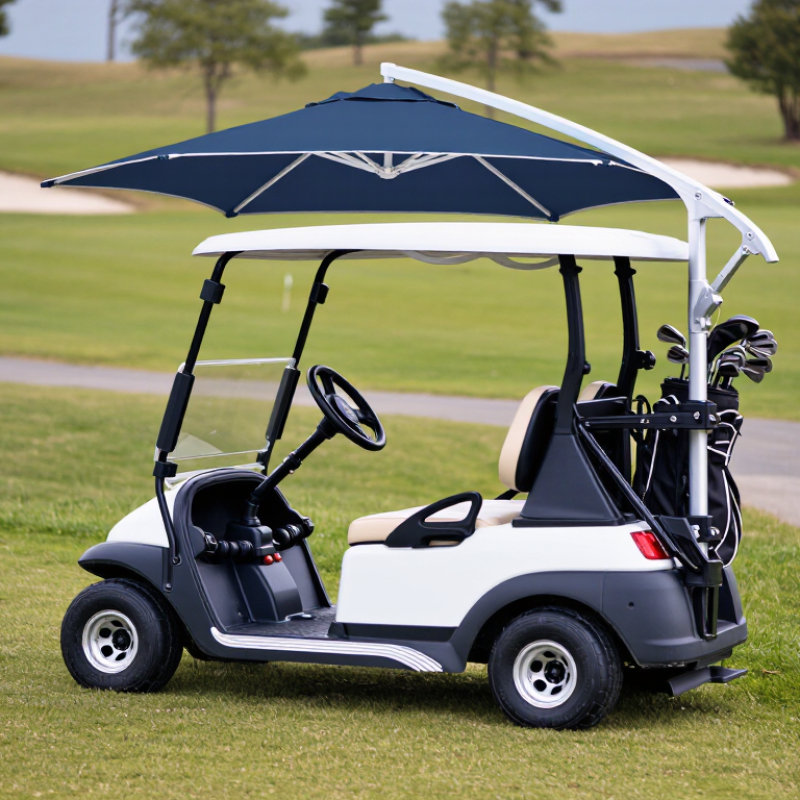
Set Coverage Goals: Compare 60–68-Inch Canopies for Two Golfers
Choosing a golf cart umbrella starts with the space two golfers actually occupy.
A 60-inch canopy usually offers about 2,827 square inches of coverage, while a 68-inch canopy provides roughly 3,632 square inches. That is nearly 29% more overhead area. The difference matters when shoulders, bags, and a moving cart share limited space.
The National Golf Foundation reported 26.6 million on-course golfers in the United States during 2023. More players also means more varied weather decisions. For two golfers, I would favor 68 inches when rain arrives sideways or clubs remain exposed. A 60-inch model can feel easier to handle on calm days. Check the shaft length, opening mechanism, and cart attachment before trusting the diameter. Bigger is not automatically better.
Wind changes the calculation.
The National Weather Service warns that gusty conditions can create sudden force on broad surfaces, including umbrellas. I have found that a large canopy protects better but becomes awkward beside a cart path. That trade-off is easy to underestimate. My first instinct was to choose maximum coverage; field testing made me reconsider. Measure the cart’s roof, seating width, and storage space. Then compare those measurements with the open canopy, not the advertised number alone.
Prioritize Sun Protection: Choose UPF 50+ Fabric Blocking 98% of UV
When choosing a golf cart umbrella, treat sun protection as the main specification, not a decorative extra. Look for UPF 50+ fabric, which blocks at least 98% of ultraviolet radiation. This rating measures fabric performance under testing conditions. It does not make every exposed area safe.
A dense, tightly woven canopy usually feels more dependable than thin, loosely knitted material. Hold the umbrella toward a bright window and check for visible pinholes. I once assumed a darker canopy always offered better protection. That assumption was wrong. Color can help, but weave density, coating quality, and certification matter more.
Check how the canopy covers your shoulders, hands, and the cart’s open sides. Strong sunlight can enter from low angles, especially during morning or late afternoon rounds. A tilt mechanism helps you keep the shade aligned as the sun moves. UPF 50+ protection can weaken if the fabric becomes damaged, stretched, or heavily worn. Inspect the seams and ribs before every season.
Do not ignore heat. A dark, sealed canopy may block UV well but trap warm air underneath. Ventilation panels can improve comfort without removing the protective fabric. Rain resistance is useful, yet waterproof coating alone does not prove UV protection. Ask for a clear UPF test result from a qualified laboratory. Marketing language can sound impressive, but evidence is more useful. Look for reliable coverage, stable mounting, and fabric that remains protective after repeated outdoor use.
How to Choose the Best Golf Cart Umbrella? Prioritize Sun Protection
Choose an umbrella fabric rated UPF 50+ to block at least 98% of ultraviolet radiation. The chart shows the minimum UV protection associated with common UPF ratings.
UV blocking is calculated from the UPF rating using the relationship: UV blocked = 1 − (1 ÷ UPF). UPF 50+ provides at least 98% UV blocking.
Evaluate Wind Performance: Check Tested Resistance of 35–55 mph
How to Choose the Best Golf Cart Umbrella?
Wind performance deserves careful attention when selecting a golf cart umbrella. A tested resistance range of 35–55 mph offers useful evidence, but it is not a promise of perfect stability. Wind at 35 mph can already twist a weak frame. Gusts near 55 mph may challenge even reinforced joints. Check whether the test measured steady wind, sudden gusts, or both. The difference matters.
Look for clear testing details. Reliable specifications should mention the wind tunnel, mounting position, test duration, and umbrella angle. A cart-mounted umbrella faces different forces than a hand-held model. Its clamp must resist lifting, rotation, and side pressure. Examine the ribs, shaft, joints, and locking mechanism closely. Thick fabric alone does not prove durability. The mounting system is often the overlooked weakness.
Real course conditions remain unpredictable. Trees, open fairways, and downhill paths can change wind direction within seconds. Keep the umbrella closed during severe gusts. That is safer and reduces stress on the frame. I would also inspect the clamp after several rounds, especially if it shows looseness or vibration marks. Testing cannot copy every course. This limitation deserves honesty. A 35–55 mph rating is a strong comparison point, not permission to ignore weather warnings. Choose the model with transparent test information, secure attachment, and parts that feel firm rather than merely heavy.
Match Materials to Use: Compare Fiberglass Ribs with 190T Polyester
A golf cart umbrella must handle more than light rain. It faces wind, sun, sudden movement, and frequent storage. Fiberglass ribs are a practical choice because they flex instead of bending sharply. This flexibility can reduce breakage when a gust catches the canopy. They also resist rust, which matters after wet rounds. However, fiberglass is not indestructible. A poorly designed frame may still twist under strong wind.
The canopy material deserves equal attention. 190T polyester offers a useful balance between weight, durability, and water resistance. Its tightly woven surface can help shed rain while providing shade on bright fairways. Look for reinforced stitching around the ribs and a smooth opening mechanism. From practical use, a slightly heavier canopy often feels more stable. Still, heavier does not always mean better. It may become tiring to carry or awkward to fit beside a golf bag. I once chose a very large umbrella and regretted it during a crowded round.
Tips: Check the rib joints by opening the umbrella slowly. Avoid models with loose stitching or exposed sharp edges. Test the handle with one hand. A secure grip matters when steering a cart. Choose a canopy size that protects your shoulders without blocking your view. Also, let the umbrella dry fully before storage. Small habits can extend its useful life.
Verify Cart Fit and Safety: Measure Shaft Diameter and Check Event Rules
Choosing the best golf cart umbrella starts with fit, not canopy size. A loose shaft can twist, slip, or obstruct the driver’s view. Measure the cart’s umbrella holder or mounting tube with calipers. Record its inside diameter, not the outside width. Then compare that measurement with the umbrella shaft.
Allow a small clearance. Too little space makes insertion difficult. Too much creates wobble. A practical target is a firm fit with minimal side movement.
Check the clamp, locking pin, and base for cracks. Test the umbrella while the cart is stationary.
I used to treat a universal shaft as automatically suitable. That assumption was wrong. Cart holders vary more than product descriptions suggest.
Safety also depends on event policy. The USGA Rules of Golf, 2023 edition, permits committees to establish Local Rules and conditions for play.
Organizers may restrict umbrellas near starting areas, charging stations, or crowded paths. Ask before arrival. The National Golf Foundation reported approximately 531 million U.S. golf rounds in 2023, meaning carts and umbrellas often share busy spaces.
The U.S. Consumer Product Safety Commission’s golf-cart injury analysis also indicates roughly 15,000 emergency-department-treated injuries annually during recent reporting periods. Secure the canopy in strong wind. Never let it block mirrors, controls, or another player’s sightline. Small details matter.